
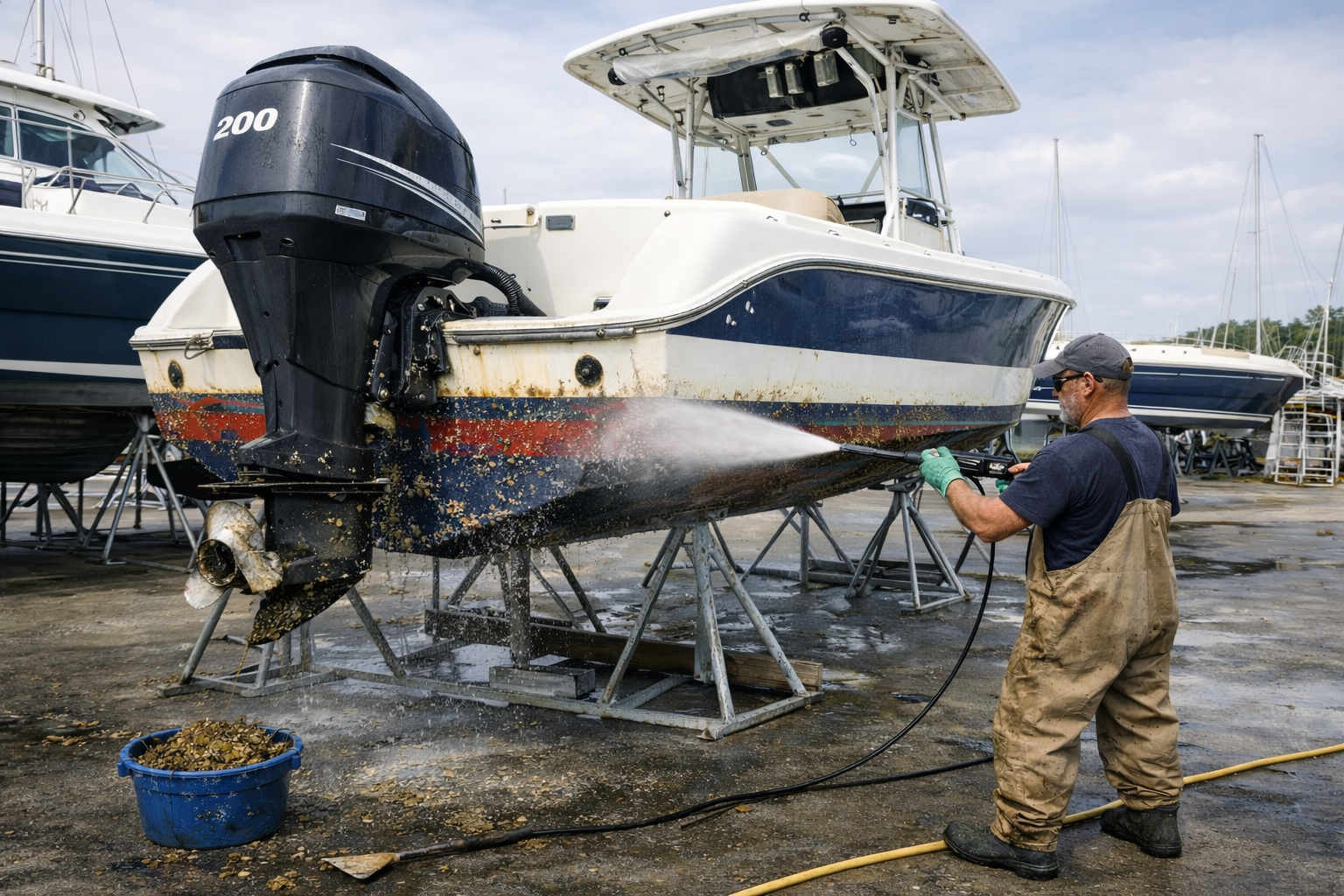
Fuel efficiency is one of the biggest ongoing costs of boat ownership, yet one of the most influential factors is also one of the least visible: the condition of your hull below the waterline.
Marine growth may seem like a cosmetic issue, but extensive research shows that even light fouling significantly increases drag, forcing engines to work harder and burn more fuel. Understanding this relationship is key to improving performance, reducing operating costs, and extending the life of your vessel.
Put simply: a dirty hull creates drag, drag burns fuel, and fuel costs money.
The Science: Why Hull Condition Matters for Boat Performance
When a boat remains in the water, its hull quickly becomes a surface for biofouling (the accumulation of slime, algae, barnacles, and other marine organisms). This growth increases the roughness of the hull, disrupting smooth water flow and increasing hydrodynamic resistance.
A landmark peer-reviewed study by Schultz (2007) demonstrated that hull roughness caused by biofouling leads to measurable increases in resistance and power demand, even when fouling is relatively light. In practical terms, this means more throttle is required to maintain the same speed, resulting in higher fuel consumption (Schultz, 2007).
Industry analysis confirms this effect, noting that underwater hull fouling creates turbulence along the hull surface, significantly increasing drag and reducing efficiency (Hull2Prop, n.d.).
Quantifying Fuel Savings: What the Data Say
Multiple independent studies and operational reports have quantified the impact of hull fouling on fuel consumption:
- Regular hull cleaning has been shown to reduce fuel consumption by up to 30% on recreational and light commercial vessels (Underwater Maintenance Services, n.d.).
- Research published in Ocean Engineering found that biofouling can increase ship resistance enough to cause fuel penalties of 9-17%, depending on the severity and type of fouling (Demirel, Uzun & Turan, 2017).
- Scientific reviews summarising multiple studies report that heavy fouling can increase total power demand by more than 40%, with corresponding increases in fuel burn (Alfa Dalgıçlık, n.d.).
Even early-stage slime layers have been shown to cause meaningful efficiency losses, long before barnacles or shell growth appear.
Fuel Efficiency, Engine Load and Long-Term Costs
As hull resistance increases, engines must operate at higher loads for longer periods. Over time, this has compounding effects:
- Higher fuel consumption, increasing operating costs
- Increased engine wear, due to sustained higher load
- Reduced cruising speed, or higher RPM required to maintain speed
A recent study in the Journal of Marine Science and Engineering confirmed that increases in hull roughness are directly linked to higher fuel consumption and emissions, even when changes in surface condition are relatively small (JMSE, 2022).
For boat owners, this means hull condition directly affects not only fuel bills, but also servicing intervals, engine longevity, and overall vessel performance.
Environmental Implications of Hull Fouling
Fuel efficiency is not only an economic issue, it is also an environmental one. Increased fuel consumption leads to higher greenhouse gas emissions and a larger operational footprint.
The International Maritime Organization (IMO) has highlighted hull fouling as a significant contributor to reduced energy efficiency across the global fleet, noting that fouling-related drag can lead to substantially higher fuel use and emissions if not properly managed (IMO, 2011).
Keeping hulls clean is therefore one of the most immediate and practical ways boat owners can reduce environmental impact without changing how they operate their vessels.
Conclusion
The evidence is clear: a clean hull directly improves fuel efficiency. Decades of peer-reviewed research and real-world operational data show that even light marine growth increases drag, fuel consumption, and engine load, while accelerating wear on key components.
References
- Schultz, M. P. (2007). Effects of coating roughness and biofouling on ship resistance and powering. Biofouling, 23(5), 331–341. Available at: https://pubmed.ncbi.nlm.nih.gov/17852068/
- Hull2Prop. (n.d.). How underwater hull cleaning improves fuel efficiency. Available at: https://www.hull2prop.com/blog/how-underwater-hull-cleaning-improves-fuel-boat-efficiency/
- Underwater Maintenance Services (UMS). (n.d.). How much fuel can you save with regular hull cleaning. Available at: https://umsflorida.com/how-much-fuel-can-you-save-with-regular-hull-cleaning/
- Dalgıçlık, A. (n.d.). Benefits of hull cleaning for ships: Summary of scientific findings. Available at: https://alfadalgiclik.com.tr/blog/benefits-of-hull-cleaning-for-ships-summary-of-scientific-findings
- International Maritime Organization (IMO). (2011). Assessment of the impact of biofouling on ship energy efficiency. Referenced via: https://www.maritime-executive.com/article/imo-study-shows-higher-than-expected-fuel-cost-from-fouling
- Demirel, Y. K., Uzun, D., & Turan, O. (2017). Effect of biofouling on ship resistance and powering. Ocean Engineering, 141, 1–10. Available via ResearchGate: https://www.researchgate.net/publication/322247268
- Marine Hydrodynamics Research Group. (2022). Impact of hull roughness on fuel consumption and emissions. Journal of Marine Science and Engineering, 10(12), 1891. Available at: https://www.mdpi.com/2077-1312/10/12/1891